December is bonus season, and every year I hear the same thing: “They told me KES 50,000, but my account shows about KES 32,000.” Nobody stole the rest. A Kenyan bonus goes through the same deductions as your salary, and in the month it lands it can push part of your pay into a higher tax band.
Here is exactly where the money goes, with real numbers you can check against our free bonus tax calculator.
Rates checked 1 November 2026. The Finance Act 2026 did not change the PAYE bands or the KES 2,400 personal relief, and the NSSF Year 4 limits (KES 9,000 and KES 108,000) have applied since 1 February 2026.
There is no special “bonus tax rate” in Kenya
KRA does not have a separate rate for bonuses. Your employer adds the bonus to your normal pay for the month it is paid, and the total goes through four deductions:
- PAYE: the usual bands of 10%, 25%, 30%, 32.5% and 35%, minus KES 2,400 personal relief.
- SHIF: 2.75% of gross pay, with no cap.
- Housing Levy: 1.5% of gross pay, with no cap.
- NSSF: 6% of pensionable pay up to KES 108,000, if your employer counts the bonus as pensionable.
SHIF, the Housing Levy and NSSF are all taken off before PAYE is worked out, so they slightly reduce the tax on the bonus.
Worked example: KES 80,000 salary plus a KES 50,000 bonus
| Normal month | Bonus month | |
|---|---|---|
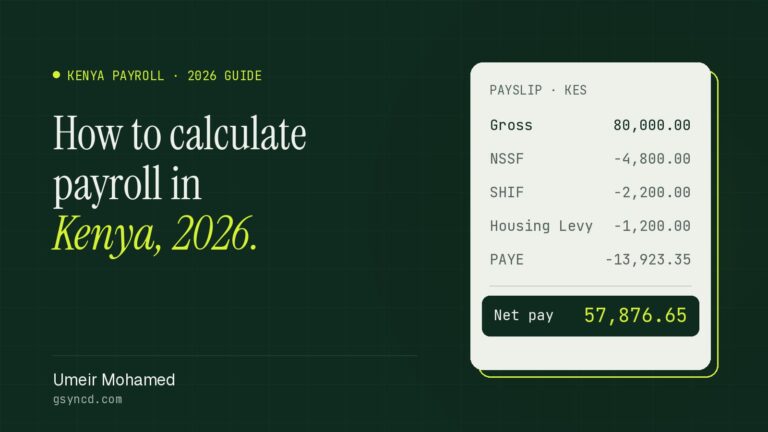
| Gross pay | 80,000 | 130,000 |
| NSSF | 4,800 | 6,480 |
| SHIF | 2,200 | 3,575 |
| Housing Levy | 1,200 | 1,950 |
| PAYE | 13,923.35 | 27,781.85 |
| Take-home pay | 57,876.65 | 90,213.15 |
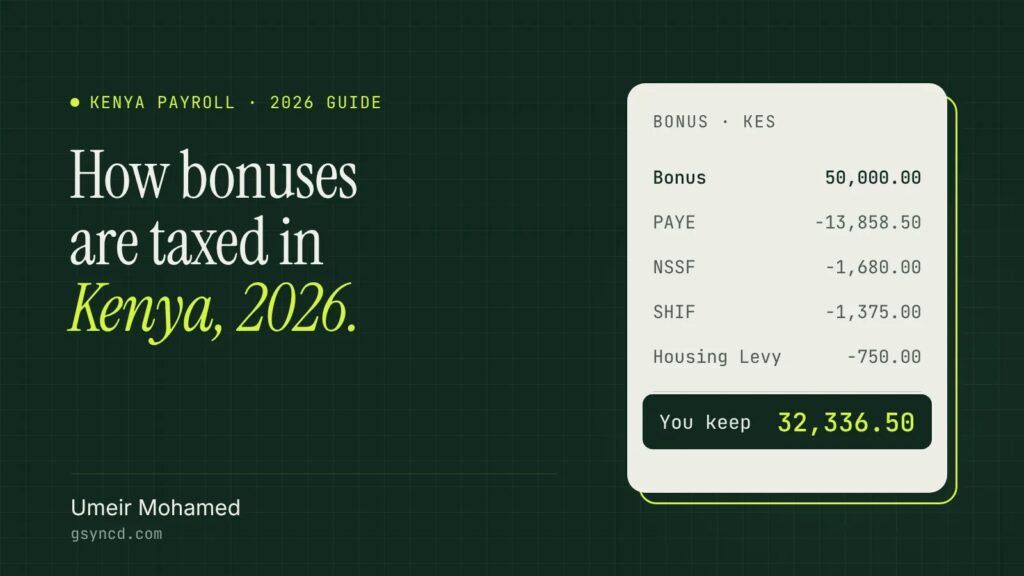
The take-home pay goes up by KES 32,336.50. That is what you actually keep from the KES 50,000 bonus, about 65%.
Where did the extra PAYE of KES 13,858.50 come from? The bonus adds KES 50,000 of pay, minus the extra NSSF (1,680), SHIF (1,375) and Housing Levy (750). That leaves KES 46,195 of extra taxable pay, all taxed at 30% because this employee’s normal taxable pay is already above KES 32,333.
How much of a KES 50,000 bonus you keep at different salaries
| Monthly salary (KES) | You keep | Deducted | Share deducted |
|---|---|---|---|
| 25,000 | 32,298 | 17,702 | 35% |
| 40,000 | 31,412 | 18,588 | 37% |
| 60,000 | 31,496 | 18,504 | 37% |
| 80,000 | 32,337 | 17,664 | 35% |
| 150,000 | 33,513 | 16,488 | 33% |
| 300,000 | 33,513 | 16,488 | 33% |
Two things stand out. First, people on middle salaries lose slightly more than high earners. That is because their NSSF also rises with the bonus, while someone earning over KES 108,000 already pays the maximum NSSF. Second, that extra NSSF is not really lost: it goes into your pension, matched by your employer.
These figures assume the bonus counts as pensionable pay. If your employer leaves it out of NSSF, you keep a little more.
Does splitting the bonus over several months help?
For most salaried people, no. On a KES 80,000 salary, the 30% band runs all the way up to KES 500,000 of taxable pay, so the bonus is taxed at 30% whichever month it lands in. Paying it in two halves actually leaves you with KES 31,412.50 instead of KES 32,336.50, because more of it goes into NSSF.
It is different for lower earners. Take a KES 25,000 salary and the same KES 50,000 bonus:
- Paid in one month: you keep KES 32,298.
- Paid as KES 10,000 a month over five months: you keep KES 35,609, about KES 3,300 more.
Spreading it out keeps each month’s taxable pay inside the 25% band instead of pushing it into the 30% band. If your normal taxable pay is well below KES 32,333, it is worth asking HR whether the bonus can be paid in instalments.
13th cheques, leave allowance and other one-off payments
The same rules apply. A 13th cheque, leave allowance, performance bonus or overtime is added to that month’s gross pay and taxed through PAYE, with SHIF and the Housing Levy charged on it too.
What about the proposed PAYE changes?
As of 1 November 2026 nothing has changed. In late October, Treasury said it would table a bill to make the first KES 32,333 of monthly income tax-free, which reports say would also remove the KES 2,400 personal relief. Parliament has not passed it. If it becomes law, lower earners would keep more of their bonuses, and I will update our calculators the same week.
For employers: getting bonus payroll right
- Put the bonus through payroll in the month it is paid, so PAYE is declared on that month’s P10. Paying it separately in cash does not make it tax-free.
- Charge SHIF and the Housing Levy on the bonus. Both apply to gross pay, so leaving the bonus out under-deducts.
- Decide whether bonuses are pensionable for NSSF and apply it the same way for everyone, in writing.
- Tell staff what to expect. A line in the bonus letter like “after tax this is about KES 32,000” saves a lot of awkward conversations in January.
This is the kind of thing ERPsyncd was built for: one-off payments go through the normal payroll run with the 2026 rates already set up. If that sounds useful, book a 15-minute demo.
Quick answers
Is a bonus taxed in Kenya?
Yes. A bonus is employment income. It is added to your pay for the month and taxed through PAYE, with SHIF (2.75%) and the Housing Levy (1.5%) also charged on it.
What percentage of my bonus goes to tax in Kenya?
For most employees, roughly a third. In our examples, between 33% and 37% of a KES 50,000 bonus went to PAYE, NSSF, SHIF and the Housing Levy.
Is a 13th cheque taxable in Kenya?
Yes. It is treated exactly like a bonus and taxed in the month it is paid.
Can I legally reduce the tax on my bonus?
Two common ways: if you are a lower earner, ask for it to be paid in instalments; and you can ask your employer to put part of it into a registered pension scheme, since pension contributions up to KES 30,000 a month (including NSSF) reduce taxable pay. Check the details with your scheme or a tax advisor.
Want your own numbers? Put your salary and bonus into the bonus tax calculator. It shows your normal payslip and your bonus-month payslip side by side.
This guide is for general information and isn’t tax advice. Rates were checked on 1 November 2026; always confirm with KRA or a qualified accountant for your situation.
— Umeir