Every month, Kenyan employers do the same maths: take a gross salary, knock off five different deductions, pay four different bodies, and hope nothing changed since last month. When I started building ERPsyncd, getting this exactly right was the whole job, so this is the guide I wish I had back then.
Below is how payroll actually works in Kenya in 2026, step by step, with a real worked example you can check against our free gross to net calculator.
Rates checked October 2026. The Finance Act 2026 (assented 23 June 2026) did not change the PAYE bands or personal relief, and the NSSF Year 4 limits have applied since 1 February 2026.
The five deductions on every Kenyan payslip
| Deduction | Employee pays | Employer pays | Reduces taxable pay? |
|---|---|---|---|
| NSSF | 6% of pay, Tier I up to KES 9,000 and Tier II up to KES 108,000 (max KES 6,480) | Matches the employee | Yes |
| SHIF | 2.75% of gross pay, minimum KES 300, no cap | Nothing | Yes |
| Housing Levy | 1.5% of gross pay, no cap | Matches 1.5% | Yes |
| PAYE | Progressive bands from 10% to 35%, minus KES 2,400 personal relief | Nothing | n/a |
| NITA | Nothing | KES 50 per employee per month | n/a |
The thing that trips people up: since 27 December 2024, SHIF and the Housing Levy are deducted before PAYE is calculated, just like NSSF. A lot of older guides and spreadsheets still calculate PAYE on the full gross, which overcharges tax.
The 2026 PAYE bands (monthly)
| Taxable pay per month | Rate |
|---|---|
| First KES 24,000 | 10% |
| Next KES 8,333 (up to 32,333) | 25% |
| Next KES 467,667 (up to 500,000) | 30% |
| Next KES 300,000 (up to 800,000) | 32.5% |
| Above KES 800,000 | 35% |
Then subtract personal relief of KES 2,400 from the tax (not from the pay). If an employee has a qualifying life or education policy, insurance relief of 15% of premiums, up to KES 5,000 a month, comes off too.
Worked example: KES 80,000 gross salary
Let’s take an employee earning a basic salary of KES 80,000 a month with no allowances or benefits.
Step 1: NSSF
Tier I is 6% of the first KES 9,000 = KES 540. Tier II is 6% of the rest up to KES 108,000, so 6% of KES 71,000 = KES 4,260. Total employee NSSF: KES 4,800.
Step 2: SHIF
2.75% of KES 80,000 = KES 2,200.
Step 3: Housing Levy
1.5% of KES 80,000 = KES 1,200.
Step 4: Taxable pay
80,000 − 4,800 − 2,200 − 1,200 = KES 71,800.
Step 5: PAYE
- First 24,000 at 10% = 2,400
- Next 8,333 at 25% = 2,083.25
- Remaining 39,467 at 30% = 11,840.10
Tax before relief: 16,323.35. Minus personal relief of 2,400 = PAYE of KES 13,923.35.
Step 6: Net pay
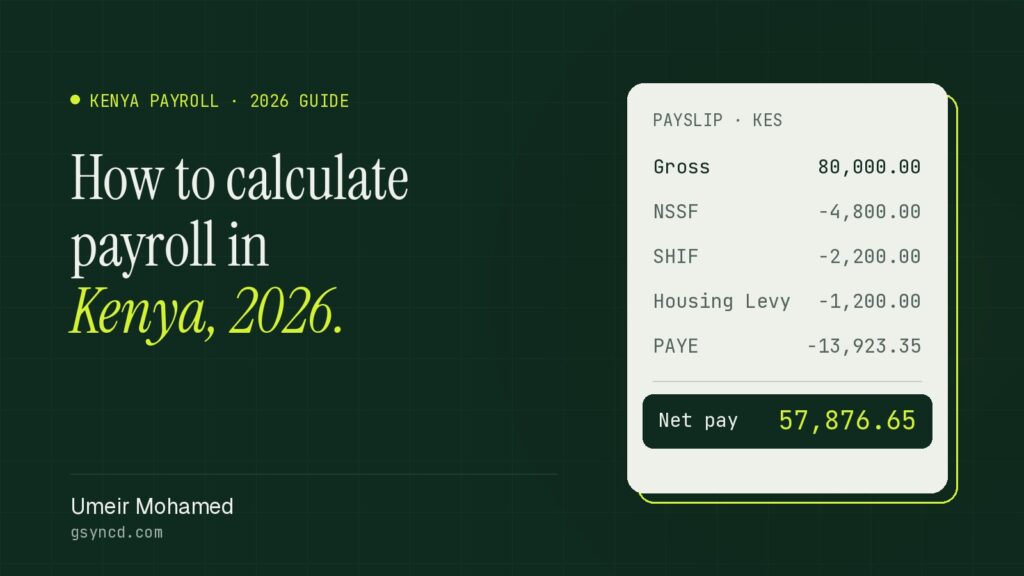
80,000 − 4,800 − 2,200 − 1,200 − 13,923.35 = KES 57,876.65 take-home.
| Line | KES |
|---|---|
| Gross salary | 80,000.00 |
| NSSF (Tier I + II) | −4,800.00 |
| SHIF | −2,200.00 |
| Housing Levy | −1,200.00 |
| PAYE | −13,923.35 |
| Net pay | 57,876.65 |
You can plug KES 80,000 into our gross to net calculator and you should get the same answer.
What this employee actually costs the employer
This is the part business owners often forget when budgeting for a hire. On top of the KES 80,000 salary, the employer pays:
- NSSF employer match: KES 4,800
- Housing Levy employer match: KES 1,200
- NITA: KES 50
So the real monthly cost is KES 86,050, not 80,000.
When and where to pay
Everything is due by the 9th of the following month. So January’s payroll deductions must be paid by 9 February.
- PAYE, Housing Levy and NITA: declared on the P10 return on KRA iTax.
- SHIF: paid through the Social Health Authority.
- NSSF: paid through the NSSF portal.
Late payments attract penalties and interest, and they add up fast, so it’s worth putting the 9th in your calendar.
Mistakes I see all the time
- Taxing the full gross. NSSF, SHIF and the Housing Levy all come off before PAYE. Skipping that means employees pay too much tax.
- Using old NSSF limits. The limits went up on 1 February 2026 (KES 9,000 and KES 108,000). Spreadsheets from last year are wrong now.
- Forgetting the SHIF minimum. Low earners still pay at least KES 300.
- Forgetting the employer side. The Housing Levy and NSSF are matched, and NITA is extra.
- Breaking the one-third rule. Under section 19(3) of the Employment Act, total deductions (statutory plus loans, Sacco and so on) can’t leave an employee with less than one third of their pay. Check it with our one-third rule calculator.
- Forgetting benefits. A company car or housing is taxable even though it isn’t cash. Our car benefit calculator works out the taxable value.
Doing this for a whole team
For one employee, a calculator is enough. For ten, or a hundred, with allowances, loans, leave, casual workers and changing rates, spreadsheets start breaking quietly.
That’s exactly why we built ERPsyncd. It runs all of the above automatically, checks the one-third rule before payday, produces M-Pesa and bank payment files, P9A forms and statutory returns, and updates centrally when the rates change. If that sounds useful, book a 15-minute demo.
And if you just want to check a single payslip, all our Kenya payroll calculators are free and need no sign-up.
Quick answers
Are SHIF and the Housing Levy tax deductible in Kenya?
Yes. Since 27 December 2024, both are deducted from pay before PAYE is calculated, the same as NSSF.
What is the maximum NSSF deduction in 2026?
KES 6,480 a month for the employee (KES 540 Tier I plus KES 5,940 Tier II), matched by the employer, for anyone earning KES 108,000 or more.
When is PAYE due in Kenya?
By the 9th of the month after the salary was paid, filed on the P10 return on iTax.
Did the Finance Act 2026 change PAYE?
No. Changes to the bands were proposed during 2026, but the Finance Act 2026 kept the existing bands and the KES 2,400 personal relief.
This guide is for general information and isn’t tax advice. Rates were checked in October 2026; always confirm with KRA or a qualified accountant for your situation.
— Umeir